Sailing · Tradition and boat trips
Sailing, yoles and catamarans in Martinique: choose the right trip
A yole ronde introduction, a sailing lesson, a crewed catamaran day and a boat rental serve different aims. First decide who will command the boat, what you want to learn and how much comfort the group needs.
Four formats that are not interchangeable
The word “boat” can describe physically demanding cultural transmission, technical instruction, a day managed by a crew or a rental whose decisions you assume. Always establish who is in command and how much participation is expected.
| Format | A good choice if… | Check before paying |
|---|---|---|
| Yole ronde introduction | You want to understand a Martinican practice and take part in manoeuvres | Supervision, required effort, equipment and ability to welcome a complete beginner |
| Sailing lesson | You want to learn sail trim, steering and reading the wind | Craft used, instructor qualification, student numbers and fallback area |
| Crewed catamaran day | You prefer an organised outing with navigation, stops and return managed for you | Actual passenger number, shade, toilets, food, time under sail and conditional route |
| Hire with or without a skipper | You want to shape the programme and accept more responsibility | Required competence or licence, inventory, insurance, deposit, permitted area and weather limits |
The Comité Martiniquais du Tourisme official directories are a useful shortlist: sailing activities, sea excursions and boat hire. A directory entry is neither a contract nor proof of insurance or availability, so verify directly.
The yole ronde: living heritage, not a folkloric catamaran
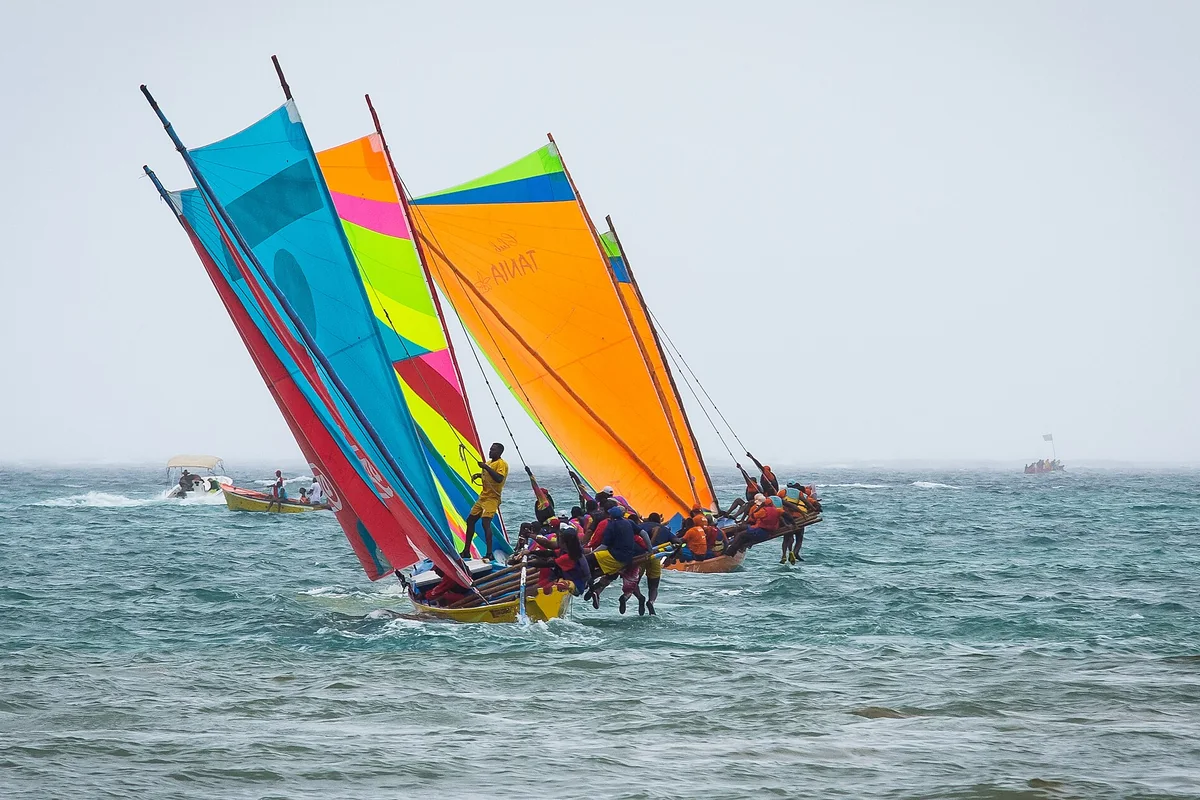
The yole ronde is a light, shallow-draught boat traditionally adapted to Martinique’s coasts. Crew members balance the hull from long movable poles; coordination and physical engagement are integral to sailing it. In 2020 UNESCO selected the safeguarding of the Martinique yole, from construction to sailing practices for its Register of Good Safeguarding Practices.
A serious introduction explains history, vocabulary, crew roles and safety before launching. Ask whether you will actually board a yole ronde, a gommier or another traditional craft: these terms are not interchangeable marketing labels.
A race is different again. The Tour des Yoles involves trained crews and temporary navigation rules. Use the official Tour page for the current programme. Do not attempt to follow a stage in a hired boat outside an organised framework; from shore or an authorised following vessel, respect published zones and instructions.
Sailing lesson or catamaran day?
In a lesson, learning is the objective. Establish how long the briefing takes, who handles the sails, how the instructor adapts exercises to the wind and what replaces the session when conditions are unsuitable.
On a crewed catamaran, the skipper retains nautical decisions. “Catamaran day” does not necessarily mean sailing throughout: motoring, anchoring and stops may occupy much of the programme. Ask for an approximate amount of navigation without demanding a fixed route that the sea could make unreasonable.
Compare concrete comfort: shaded seating, exposed deck, toilets, bathing ladder, dry storage, the option to remain aboard during a stop and vessel movement. Two hulls remove neither seasickness nor wind and swell.
Check the operator, vessel and capacity
Ask in writing for:
- the operator’s legal name and full contact details;
- the framework under which the vessel carries or teaches passengers;
- the skipper’s professional credential or instructor qualification appropriate to the activity;
- insurance covering the offered activity and passengers;
- authorised maximum capacity and the number planned that day;
- the type, name or registration of the vessel that may be used;
- the emergency procedure and available safety equipment.
Rules differ between a school, a professionally operated pleasure vessel and bareboat hire. The official page on professional pleasure-vessel regulation explains, among other things, the navigation permit for vessels within its scope. Do not guess the category; ask the operator to state which framework applies.
Every child counts towards stated capacity. If the answer changes depending on whom you contact, do not pay until you receive consistent confirmation.
Children: a proper lifejacket that fits
Give every child’s age and weight before booking. A tightened adult jacket is not a children’s lifejacket. Equipment must be approved, fit the wearer, be tried on and be worn as directed by the person in command. For pleasure craft governed by Division 240, the administration states that a child weighing no more than 30 kg must have personal flotation equipment rated to performance level 100 regardless of distance from shelter; verify the rule and equipment applying to your vessel on the official pleasure-craft safety standards page.
Also ask about netting or guardrails, areas prohibited during manoeuvres, shade, water, toilets, the option to skip a swim and how many adults are genuinely free to supervise. Crew occupied with manoeuvres do not automatically become childcare. Keep a child within immediate reach around propellers and quays.
Weather, route and seasickness
Check Météo-France Martinique warnings and the coastal marine forecast, but leave the operational decision to the skipper. Wind, swell, squalls and visibility may move a stop, shorten swimming or require cancellation. That change may indicate good management.
Mention susceptibility to seasickness before departure and seek medical advice about medication. Pack water, sun protection, a spray-resistant layer and dry belongings in a suitable bag. Do not drink alcohol before an introduction, a manoeuvre or taking the helm.
Read the itinerary and cancellation terms
The booking document should give the exact pontoon, meeting time, estimated finish, inclusions and conditional elements. Check meals and allergens, drinks, mask and snorkel, towels, showers, landing on an islet and required swimming ability. No stop, sunset, wild animal or passage under sail should be treated as guaranteed when conditions decide otherwise.
Distinguish cancellation by the customer, cancellation by the operator and a safety-driven route change. For each, ask about rescheduling, refund, credit and decision deadline. An advertising photograph does not replace those clauses.
Hire: measure the responsibility before the freedom
For bareboat hire, describe your experience honestly. Confirm the required licence, navigation area, wind limits, permitted moorings, fuel, assistance and return process. Complete a joint inventory, photograph hull, propellers and equipment, and read the excess and deposit terms.
With a skipper, clarify what remains payable by you: provisions, fuel, harbour charges, cleaning, overnight costs and route decisions. “Private” does not mean the customer can impose a dangerous route or prohibited anchorage.
Mooring and the marine environment
An anchor and chain can uproot seagrass or break coral. Use authorised facilities and let the skipper select a compatible bottom. The Direction de la Mer de la Martinique gathers maps and rules by municipality; the public Nav&Co application helps identify regulations, markers, seagrass and reefs.
Do not feed, touch or chase wildlife. Keep your distance, retain waste aboard and never land where access is prohibited. Before swimming, identify the ladder, current, other boats and recall signal.
Before booking
- choose the format before choosing a boat;
- verify the operator, capacity, insurance and supervision;
- disclose age, weight, mobility, swimming ability and allergies;
- read the itinerary as conditional on the sea;
- save the pontoon on a map, not just the municipality;
- accept a reasonable fallback.
If the outing anchors your holiday, compare road times in where to stay in Martinique. For a wildlife-focused activity, also read our dolphin excursion guide: responsible sailing never needs to guarantee an animal.
Useful points on the ground
Addresses and maps
Marina du Marin
Le MarinMartiniqueA major sailing and charter area; the contract must give the exact quay, pontoon and office.
Pointe du Bout
Les Trois-ÎletsMartiniqueA departure area for some Caribbean-coast excursions; do not confuse the public ferry landing with your operator's meeting point.
Baie du Robert
Le RobertMartiniqueAn Atlantic area for sailing and islets; routes, landings and mooring remain subject to current rules and conditions.