Heritage · Fort-de-France
Pavillon Bougenot in Fort-de-France: visit and heritage walk
Pavillon Bougenot is a late-19th-century residence linked to the sugar economy and later used as an annex of the Schœlcher Library; confirm access before visiting.
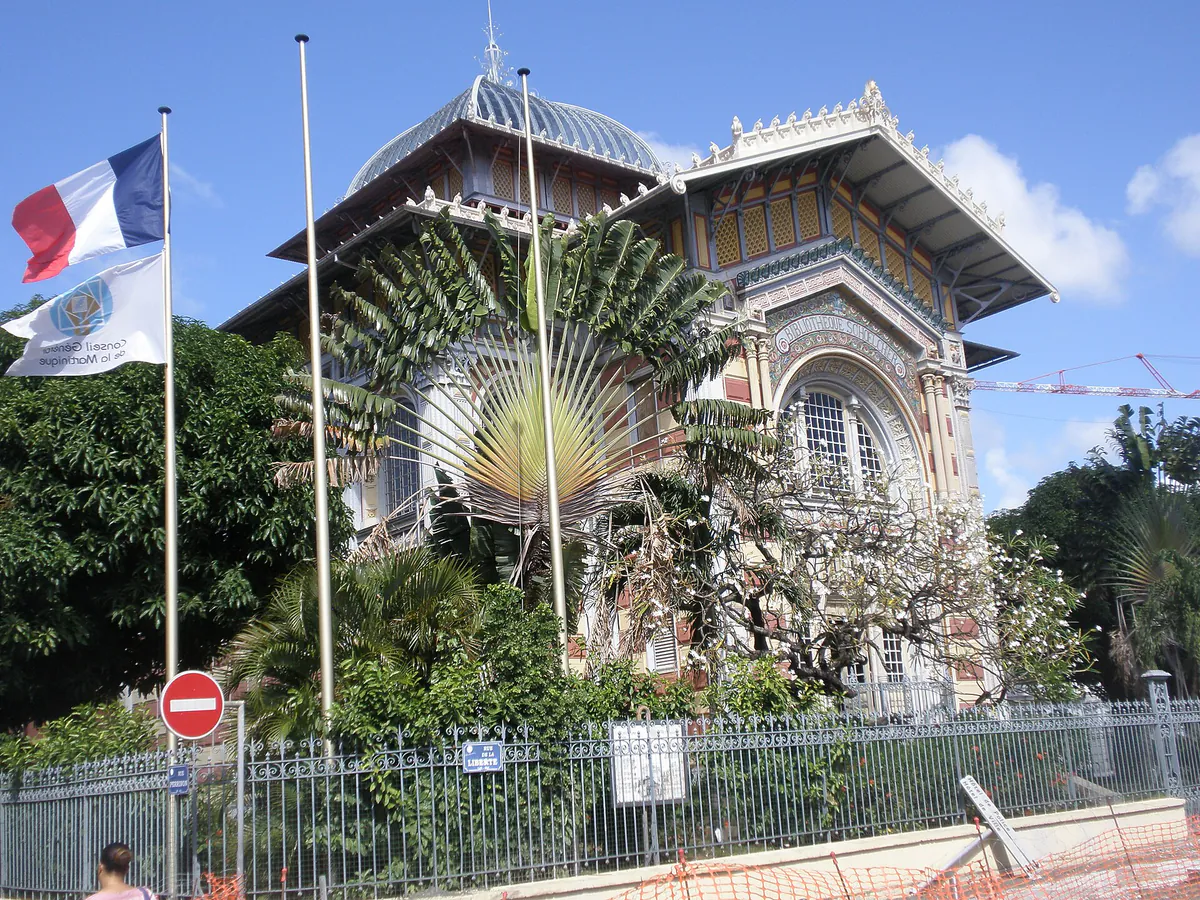
Pavillon Bougenot is easy to miss in a list of Fort-de-France’s major landmarks. It has neither the immediately recognisable outline of the Schœlcher Library nor the scale of Fort Saint-Louis. Its interest is more specific: a late-19th-century upper-class residence associated with Émile Bougenot and the sugar economy, later used as a library annex.
The current Terres du Centre tourist-office page places the pavilion at 82 rue Victor Sévère and describes architecture combining wood, metal and masonry. It also presents its role as a press and multimedia resource centre. Confirm reception arrangements for the intended day: a function listed in a directory does not guarantee that every room can be entered without an appointment.
What the building can tell you
The tourist office describes Émile Bougenot as a French engineer connected with the island’s sugar interests. A residence bearing his name provides a way to examine the place of the industrial bourgeoisie in late-19th-century Fort-de-France: material choices, adaptation to the climate, social display and proximity to civic institutions.
This reading must not detach the house from the economy that made it possible. Sugar wealth belongs to a long history of colonisation, slavery, abolition, and then deeply unequal relations of labour and property. If interpretation is offered, ask how the site documents agricultural and industrial workers, owners, techniques and social change—not just the resident’s biography.
The pavilion, library and misleading search results
The Schœlcher Library is the large colourful building near La Savane, designed by Henri Picq, exhibited in Paris before being transported and reassembled in Fort-de-France. Pavillon Bougenot is a different building used as an annex. The image on this page deliberately shows the library and functional connection; it does not claim to depict the pavilion.
Search engines create another possible confusion: a Maison Bougenot is listed in Basse-Terre, Guadeloupe. It is not Pavillon Bougenot in Fort-de-France. Always verify the municipality, département and address before following a heritage listing or map.
Can you visit inside?
The tourist office publishes visitor information, but hours, services, room access and works can change. Before making the pavilion the focus of the day:
- open the tourist-office listing;
- use the listed number or service to make contact;
- ask whether the public enters freely, by appointment or as part of an activity;
- ask which spaces are accessible and whether interpretation is available;
- confirm access for a wheelchair, pushchair or person who finds stairs difficult.
If the interior is inaccessible, observe only from public space and continue the urban route. Never cross a gate or enter a closed courtyard for a better photograph.
A coherent heritage walk through the centre
The best way to include the pavilion is a short walk linking a few places that are genuinely open, rather than a race to every point on a map.
1. Schœlcher Library
Begin by examining its metal architecture and history as a library. Confirm access and respect its use: this is a cultural facility, not merely a photographic backdrop. The Centre Martinique tourist office publishes an official heritage map connecting the library, pavilion and other landmarks, but operational information in that edition requires updating.
2. Pavillon Bougenot
Go to the confirmed address and take time to look at the materials, ventilation, volumes and relationship with the street. If a visit is offered, use it to connect domestic architecture, the sugar industry and later cultural functions.
3. La Savane and the urban waterfront
La Savane provides an open pause and helps explain the proximity between civic buildings, bay and fort. Monuments in public space have their own histories and controversies; read current interpretation rather than repeating an old legend without context.
4. Théâtre Aimé Césaire or Grand Marché
Choose one fourth stop according to what is open. Théâtre Aimé Césaire introduces civic and cultural life; the Grand Marché shows another side of the centre without guaranteeing that every stall or service operates at every hour. The City of Fort-de-France and tourist office are the right places to check.
Arriving without a car
Central Fort-de-France is better suited to walking than repeated short car journeys. If arriving by bus, TCSP, ferry or inter-island boat, save the exact terminal and plot the walking route. Cruise quays and ferry terminals are not all in one place.
Consult Martinique Transport for land and sea networks. Keep one ferry or bus in reserve, especially when returning to Les Trois-Îlets. A cultural visit that runs long should not force you to race for the final connection.
By car, use authorised parking and complete the centre on foot. Do not treat the pavilion’s address as a promise of parking at the door.
Accessibility and urban comfort
The tourist office indicates access for people with reduced mobility, but that label does not describe the entire journey. Ask about the route from the pavement, entrance width, accessible levels, toilets and available assistance. Also check the route between buildings.
Fort-de-France can be hot and humid. Carry water and light rain protection, use shoes suited to pavements and rest in shade. For somebody sensitive to heat, two buildings confirmed open are better than an overfilled route.
How to read the site without simplifying its history
Use three columns in your notes:
| What you see | Historical question | Source to seek |
|---|---|---|
| Materials and façade | Where did the techniques come from, and who built it? | Architectural interpretation, archives and inventory |
| Émile Bougenot’s name | Which industrial and land interests did he represent? | Economic archives and the history of Le Galion |
| Present cultural function | When and why did the residence become an annex? | Library, local authority and tourist office |
| Surrounding district | How did the civic centre evolve? | Old maps, current interpretation and urban history |
This method avoids reducing the residence to a “beautiful colonial house”. It also leaves room for uncertainty: if a guide or panel does not document a point, record the question rather than inventing an answer.
Sources to check before visiting
- Terres du Centre — Pavillon Bougenot
- Official heritage map of central Fort-de-France
- City of Fort-de-France
- Martinique Transport
Confirm directly: interior access, available services, appointments, accessibility, works and photography rules. Never reproduce opening hours from an old map as current information.
Useful points on the ground
Addresses and maps
Pavillon Bougenot
82 rue Victor Sévère97200 Fort-de-FranceMartiniqueThe tourist office gives this address. Confirm visitor access directly rather than relying on a map pin or old opening hours.
Schœlcher Library
1 rue de la Liberté97200 Fort-de-FranceMartiniqueA separate building pictured on this page and a useful anchor for understanding the pavilion's stated annex function.