The Caribbean north
Saint-Pierre, Martinique: understand the town before walking its ruins
Saint-Pierre makes more sense in a simple order: learn the context of 1902, read the remains within today's town, then understand the volcanic landscape linking the bay to Mount Pelée.
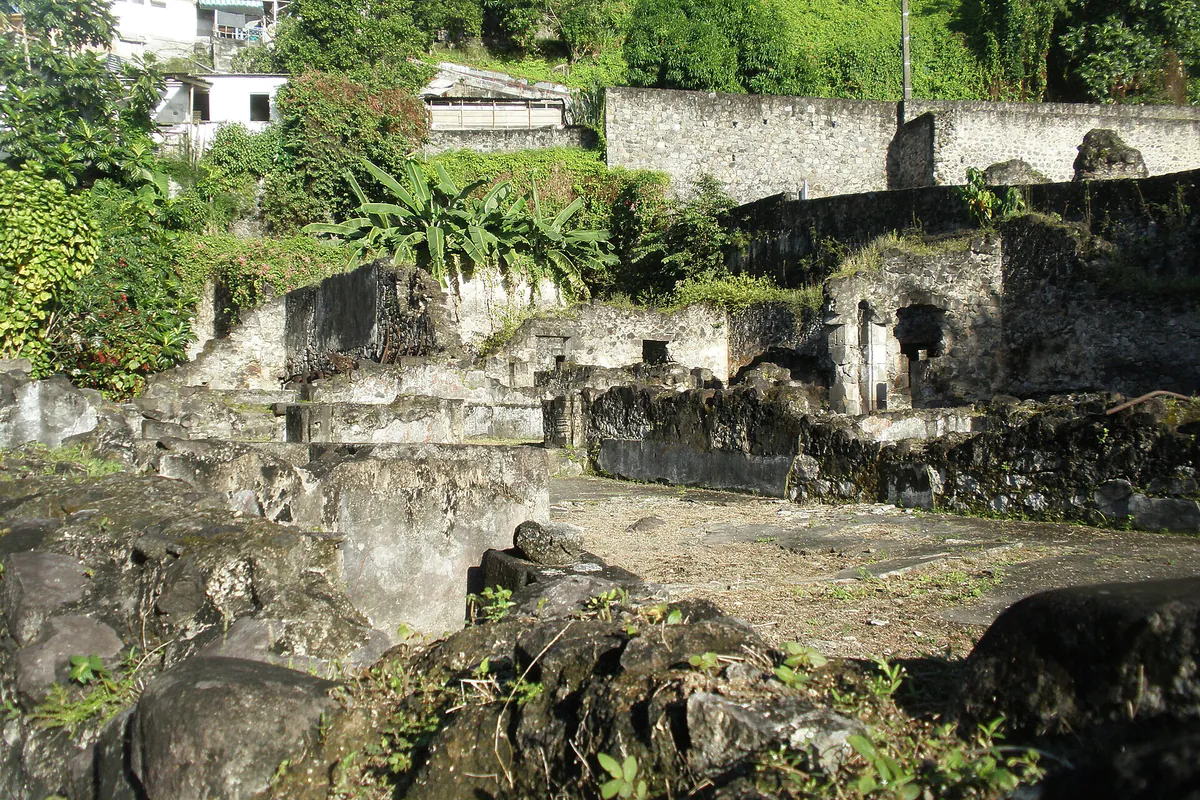
Saint-Pierre is a living town built among and above the traces of the disaster of 8 May 1902. A pyroclastic flow from Mount Pelée destroyed the town and caused an immense loss of life. The UNESCO listing for the volcanoes and forests of northern Martinique now recognises the event’s global importance in the history of volcanology.
The visit deserves a sober approach: the walls, objects and names refer to real lives, not an abandoned film set.
Begin with the context, not Cyparis’s cell
Popular retellings often focus on a handful of survivors, particularly Louis-Auguste Cyparis. Starting with that story alone, however, reduces the disaster to an anecdote. An interpretation space such as the 1902 disaster memorial helps place the remains within the pre-eruption town, the volcanic chronology and the human scale of the event.
Check admission, available languages, accessibility and current conditions directly with the site. If the memorial does not fit your itinerary, at least read the official introduction to Saint-Pierre before walking around the ruins.
A walking order that makes the remains legible
1. The waterfront and shape of the town
From the bay, look at the narrow strip between the sea and high ground. It explains the sloping streets, the historic relationship with the port and the constant presence of Mount Pelée. Locate your return route and parking place before walking uphill.
2. The theatre and old streets
The theatre remains help convey Saint-Pierre’s cultural importance before 1902. The ruins are dispersed through the modern town, so follow a heritage map or guided route instead of looking for a single enclosed site.
3. The prison ruins
The prison area and the cell associated with Cyparis make more sense after learning the wider context. Surfaces may be uneven; do not cross a barrier to get a photograph.
4. The market and present-day town
Finish in places used by residents today. The rebuilt covered market is a reminder that Saint-Pierre did not freeze in 1902. The Comité Martiniquais du Tourisme listing is the place to verify practical information.
Should you combine Saint-Pierre and Mount Pelée on the same day?
Only when the hike is short, suitable for the group and supported by the weather forecast. An ascent is a separate physical commitment: wet ground, wind, cloud and elevation gain do not disappear because the town looks close on a map.
| Your priority | The most coherent plan |
|---|---|
| Understand 1902 | Memorial, ruins and central Saint-Pierre |
| Walk on Mount Pelée | Make the hike the day’s main activity, with a short town stop if energy permits |
| Learn about rum | Saint-Pierre followed by a confirmed visit to an estate in the area |
| Explore the Caribbean north | Historic centre, one coastal stop and a return that does not cross the whole island |
Read the Mount Pelée hiking guide before combining the two.
Depaz: distinguish the estate, production and tasting
The Depaz estate sits above Saint-Pierre in a sugar-cane landscape dominated by Mount Pelée. Before adding it, establish what is actually accessible: the estate house, outdoor trail, production installations, shop and tasting are not necessarily one single visit.
If you are driving, plan the tasting accordingly. The driver can choose not to drink; an offered tasting is never an obligation. The Martinique rum distillery guide provides a useful comparison framework.
Getting there and moving around
The Caribbean-north road has attractive views but also passes through towns and winding sections. Do not use an app’s minimum journey time as a guaranteed arrival time. Save the precise location of your first stop, not merely “Saint-Pierre”.
In the centre, heat, gradients and uneven surfaces may make the loop more demanding than it looks. If someone has reduced mobility, ask each site about its accessible entrance and suitable drop-off point; the presence of a driveable street does not prove that a ruin is accessible.
Sources to consult before visiting
- Saint-Pierre, Comité Martiniquais du Tourisme;
- the official “Visiter Saint-Pierre” circuit, to identify heritage stops;
- UNESCO: volcanoes and forests of Mount Pelée, for geological and heritage context;
- Martinique historic sites and monuments, to find the relevant site pages.
Then confirm opening hours, access, guided-tour availability and any restrictions directly with each site.
Useful points on the ground
Addresses and maps
Historic centre of Saint-Pierre
97250 Saint-PierreMartiniqueUse the centre as your starting point, then locate each ruin before climbing the sloping streets.
1902 disaster memorial
97250 Saint-PierreMartiniqueConfirm current visiting conditions with the site before travelling.
Château Depaz and estate
97250 Saint-PierreMartiniqueA visit to the estate is a separate outing from the ruins; confirm access and the content of the visit offered.